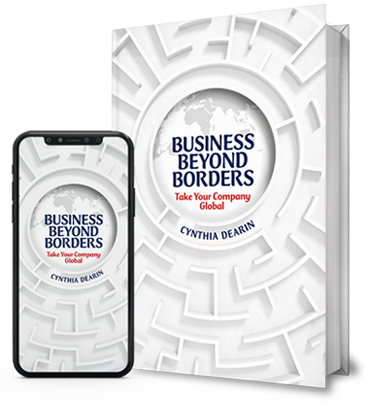
Interested in expanding your business internationally and learning more about international modes of market entry? Pick up a copy of my latest book, Business Beyond Borders: Take Your Company Global.
If you sell consumer products and you’re keen to launch into the international space, e-commerce is a great way to test overseas markets, with minimal risk, from the comfort of your own home or office.
But given the ever-expanding number of e-commerce platforms, how do you work out which one you should be using?
Let’s start by breaking down the ocean of options into a couple of categories – marketplaces and e-commerce sites.
A marketplace is like a supermarket – it’s a website that offers a variety of products from multiple sellers to various types of customers. Customers go to the website and search for the products that they need, and your products appear alongside other suppliers’ offerings. Amazon, eBay, and Etsy are examples of popular marketplaces.
E-commerce sites like Shopify, Magento or WooCommerce on the other hand are platforms that let you build your own online store. Rather than selling alongside other sellers, you get to choose your own domain and customise the look and feel of your online space, so that it reflects and amplifies your brand.
How Marketplaces Work
There are three parties in a marketplace: the marketplace administrator (the one who owns the website), the vendors and customers.
The marketplace administrator attracts potential clients, promotes products to them (based on what they search for) and offers a safe shopping experience. Sellers advertise their products and generally speaking, once a customer makes a purchase, it is the seller’s responsibility to store, pack and ship the products. Amazon is an exception to this rule as it offers sellers both the option of fulfilling orders themselves (Fulfillment by Seller) and fulfilling orders on the seller’s behalf (Fulfillment by Amazon).
Many marketplaces make money by charging sellers and customers a commission of between 5% and 15%. Some charge a flat membership fee, others offer a combination of commission and fees.
How E-Commerce Sites work
Ecommerce sites sell a single vendor’s products to multiple customers. E-commerce sites let you build websites for your brand. You choose your own domain and customize most aspects of the look, feel and functionality of the site, enabling you to stand out from other competitors and promote your brand.
Because the website belongs to you, you’re not directly competing with other people’s products.
E-commerce sites generally operate on a subscription model, with fees starting from as little as $5/month and ranging into hundreds of dollars per month.
So which one should you choose?
It depends.
Marketplaces and e-commerce sites each have pros and cons and your choice should reflect what you sell, what you’re trying to achieve and what stage your business is at.
Let’s do a quick comparison of two of the most popular platforms, Amazon (a marketplace) and Shopify (an e-commerce site).
| Amazon | Shopify | |
|---|---|---|
| How it works | Is an enormous online store. | Lets you rent a space to build your own online store. |
| Reach | Amazon technically gives you access to an enormous customer base. It has 300+ million user accounts in over 180 countries and 2.4 billion monthly visits. In 2021, US-based Amazon sellers sold 3.8 billion products. However, while your customers are on Amazon, so are your competition, and your products will compete against theirs for popularity and visibility. |
None initially. You’ll need to put a lot of effort into SEO, content marketing, online advertising and online PR in order for your store to start gaining visibility and customers. |
| Control | Low. Amazon can change its terms of business or its recommendation algorithms any time it likes, which can — in extreme cases — sink a successful business. | High. If you are successful, you will have a powerful online asset that you control fully. |
| Design and customisation | Minimal flexibility to control how your products are presented and sold – you’ll struggle to create a ‘bespoke’ shopping experience. | Flexibility to customise your store including what your storefront looks like, how your brand is presented, how you advertise and sell products and capture data. |
| Multi-currency and multilingual features | Amazon sets the rules when it comes to which languages your customer receives information in and which currency they pay in. | Shopify’s multi-currency and multi-lingual tools allow you to customize the user experience to create a very bespoke shopping experience tailored to a particular buyer persona, market or location. |
| SEO | Amazon’s SEO is dependent on the Amazon search engine, which is the second-biggest in the world, and used for 74% of all product searches.
You’ll need research SEO techniques for Amazon’s search engine. |
With a Shopify store, the main search engine you’ll need to worry about is Google — when you run your own store on your own domain, it’s the main search engine that will be presenting your products to the world.
You’ll need to research SEO techniques for Google. |
| Product fulfillment | You can either: • ship products yourself, or • send them to Amazon for fulfillment using its “fulfillment by Amazon” (FBA) service. |
You can either: • ship your own goods, setting your own shipping rates based on product weight, price, quantity, etc., or • connect your Shopify store to a third-party fulfillment service. |
| Customer support | Hands off | Hands-on |
| Pricing | Amazon offer two payment plans: • Individual — $0.99 per item sold • Professional — $39.99 per month |
Shopify offers five monthly pricing plans: • Shopify Starter — $5 per month • Basic Shopify — $29 per month • Shopify — $79 per month • Advanced Shopify — $299 per month • Shopify Plus — custom pricing according to requirements. |
As you can see – even though we’ve only compared two platforms – there are some significant differences between between marketplaces and e-commerce sites.
Generally speaking, as you think about which route to take as you get started with international e-commerce, I’d suggest that you…
…start with a marketplace if you….
-
Are new to e-commerce
-
Are new to a particular market and want to test demand
-
Want access to a ready-made international customer base
-
Don’t want to deal with SEO and web design
-
Don’t need to create a bespoke shopping experience
-
Are comfortable with the platform controlling most aspects of the sale process.
Start with an e-commerce site if you…
-
Are a seasoned e-commerce player
-
Understand the demand and customer preferences in the new country you’re targeting
-
Are confident generating demand from scratch
-
Have products that are already popular
-
Need to customise the shopping experience to amplify your brand
-
Want to customise the shopping experience to feature particular payment gateways or languages
-
Prefer to retain control over most aspects of the sales process
Interested in expanding your business internationally and learning more about international modes of market entry? Pick up a copy of my latest book, Business Beyond Borders: Take Your Company Global.